














Obesity
Accelerate your obesity trial timelines with solutions designed for rapid execution by leveraging our team of seasoned experts and advanced patient recruitment solutions.
Obesity has become a prominent subject in recent years, propelling groundbreaking therapeutic innovation and reshaping policy discussions about the tools needed to prevent and manage noncommunicable diseases (NCDs). Advocacy efforts to position obesity as a central public health concern have also focused their attention on the need for earlier, more comprehensive behavioral programs and healthier food environments. Although progress varies across geographies, advances in these areas are opening a new chapter in the obesity journey. If pharmacotherapeutic approaches and policy interventions can help people living with obesity lead healthier lives, reduce the incidence and prevalence of NCDs, and build more productive and resilient societies, how can these tools be made accessible to everyone, regardless of where they live or their ability to pay? What will accomplishing this goal require of health systems to ensure their readiness?
Discussions at the International Congress on Obesity (ICO) in Mexico City in July 20261 underscored that metabolic health is entering a new maturity phase. The central debates are no longer primarily scientific. Stakeholders increasingly recognize that effective therapies exist and that innovation will continue. The more difficult issue is to ascertain how obesity can be consistently recognized as a chronic disease and addressed comprehensively from a public health perspective, with obesity and its related comorbidities integrated into primary healthcare and coherent care pathways.
Access and implementation considerations become more complex when obesity is understood through the lens of broader health outcomes. During ICO, obesity was consistently framed as a condition linked to metabolic, cardiovascular, and mental health outcomes rather than as a weight-management issue alone. Sessions explored its relationship with diabetes, cardiovascular disease, metabolic dysfunction-associated steatohepatitis (MASH), sleep disorders, and other chronic conditions. From this perspective, obesity-management medicines (OMMs) are increasingly viewed as tools for improving overall health rather than solely as treatments for weight loss.
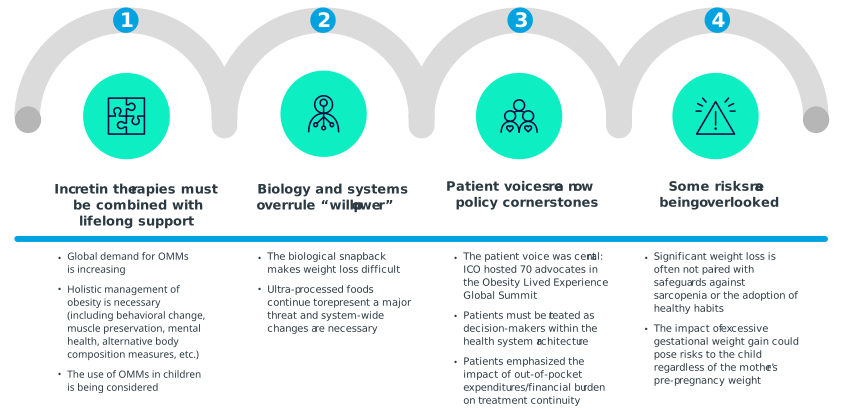
Summary of ICO 2026’s key takeaways
Source: IQVIA Thought Leadership
Abbreviations: OMM = Obesity-management medicines
Against this backdrop, the future of obesity increasingly depends on care implementation. Therefore, a number of critical questions are associated with this statement:
For many years, obesity was frequently discussed as a lifestyle issue, a matter of individual responsibility, or a risk factor for other conditions rather than as a chronic disease in its own right. Even though substantial progress has been made, including the classification of obesity as a chronic, relapsing condition by WHO,2 this challenge has not disappeared. Formal recognition matters because it shapes policy priorities, clinical practice, financing, and the language used to describe people living with obesity.
During ICO, participants repeatedly highlighted that recognition remains highly variable across countries, influencing reimbursement decisions, standards of care, and access pathways. Achieving greater consistency across countries and levels of care within them is, therefore, fundamental to designing and implementing robust obesity programs. Recognition alone will not guarantee access, yet it creates a foundation on which clearer responsibilities and more coherent pathways can be built.
Put simply, failing to understand obesity as a critical public health issue can delay access to appropriate care for underserved and vulnerable groups, perpetuate stigma among healthcare professionals, and add to health system costs. Obesity is associated with substantial clinical and economic burdens through its relationship with NCDs, disability, and reduced productivity. Policy gaps can affect individual outcomes as well as national budgets and wider social and economic resilience.
A clearer picture of the problem requires better data. National authorities, regional bodies, civil society, and multilateral organizations should support the development and effective use of NCD surveillance systems and registries that monitor obesity trends alongside other relevant indicators.3 The patient perspective should be central to these data systems, with lived experience systematically captured across issues ranging from quality of care to treatment experience and outcomes. Better recognition, in other words, should lead to better measurement and, ultimately, more informed decisions about access and pathway optimization.
The value of obesity registries
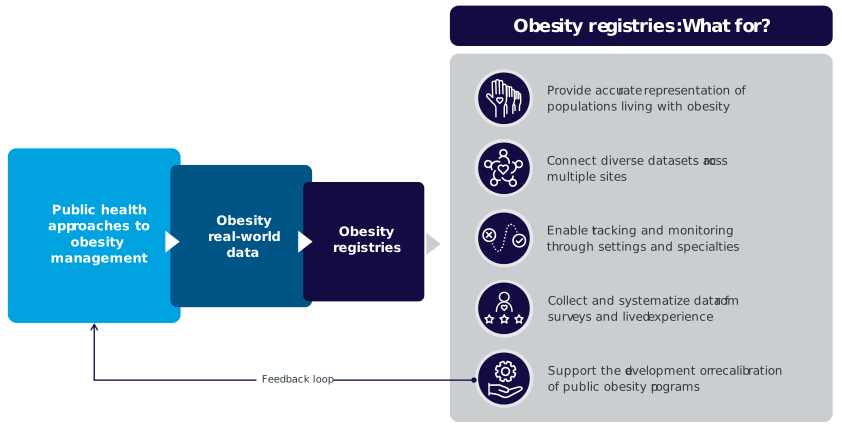
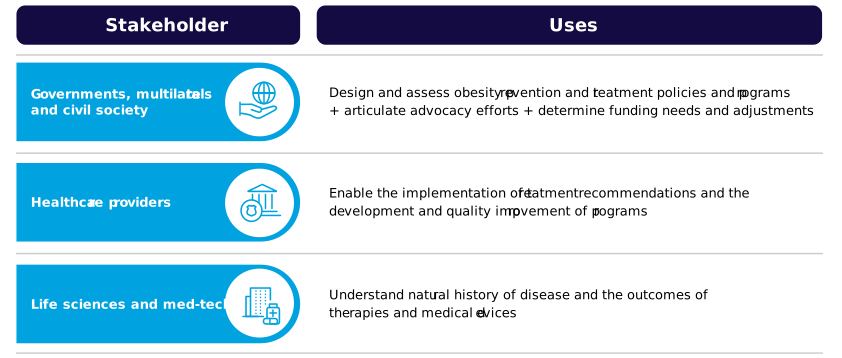
Obesity registries can help generate the real-world evidence needed to support the effective and sustainable scale-up of OMMs. Beyond tracking clinical outcomes, they can identify population needs, improve patient segmentation, inform reimbursement and care pathways, and strengthen decision-making around health system investments. As obesity treatment evolves rapidly, registries offer an opportunity to better understand disease burden, monitor outcomes, and address obesity-related comorbidities across the wider NCD landscape.
Source: IQVIA Thought Leadership
Scientific innovation continues to command enormous interest, and understandably so. ICO featured extensive discussions of glucagon-like peptide-1 (GLP-1) medicines, next-generation incretin therapies, precision-medicine approaches, and other tools spanning appetite regulation, neurobiology, metabolism, and body composition. Access, however, emerged as a central theme. Affordability remains a challenge, but cost is only one component of a broader implementation problem. Provider awareness, reimbursement frameworks, diagnostic capacity, health system infrastructure, and long-term care pathways all influence whether innovation translates into meaningful outcomes for patients.
These challenges are particularly visible in low- and middle-income countries (LMICs), where access to obesity care may depend heavily on out-of-pocket expenditure. As a result, scientific advances could potentially widen inequalities unless they are accompanied by deliberate efforts to improve access and strengthen health system capacity. The central dilemma extends beyond whether a medicine is available and should rather focus on the identification, assessment, treatment, and support to people over time within functioning care pathways.
Circulation of obesity-management medicines across different income-group countries
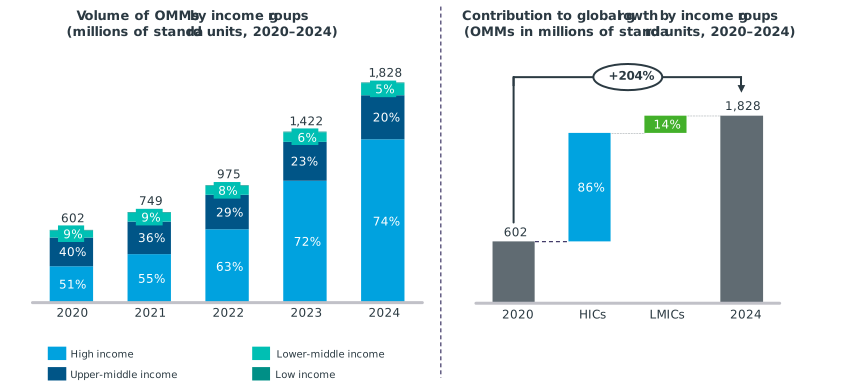
A recent IQVIA comparative study4 presented at ICO 2026 concluded that LMICs contributed 14% of the growth of total OMMs sales volume between 2019 and 2024, with these countries capturing 26% of the market share across the most representative obesity agents.
Source: IQVIA MIDAS and IQVIA Thought Leadership
Abbreviations: HICs = High-income countries | LMICs = Low- and middle-income countries | OMM = Obesity-management medicines
The prospect of lower-cost products entering obesity markets could alter the conversation substantially. Many health systems have approached OMMs primarily as high-cost interventions. Greater competition may make that framing harder to sustain, particularly if evidence demonstrates that these medicines can become a key component of cost-effective strategies and reduce the broader NCD burden. Those propositions will need to be assessed by country, population, indication, and time horizon rather than assumed to apply uniformly.
An important realization, as indicated earlier, is that lower prices alone are unlikely to resolve access challenges. Countries face different constraints, and successful delivery depends on capabilities ranging from diagnosis and provider training to patient support, supply continuity, financing, and reimbursement. As demand grows, health systems will also need to define eligibility, monitor outcomes, and manage long-term treatment responsibly. Innovation may expand what is possible, while implementation influences whether that potential becomes sustainable impact.
Affordability: An IQVIA comparative analysis
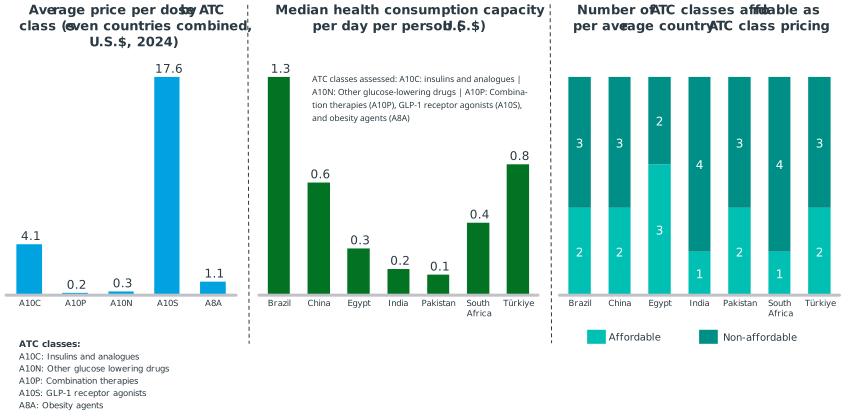
The same study referenced above, which included LMICs with the highest number of people living with obesity in absolute terms in each WHO region, also concluded that the average price per dose across the anatomical therapeutic chemical (ATC) classes assessed comes to US$0.50. This is in stark contrast with a median health consumption capacity per person per day—or the average amount an individual can spend on healthcare each day—in most of the sample countries of (or under) US$0.30. In the case of GLP-1s, their average cost is US$17.60 per dose, placing them far beyond reach for nearly all income deciles. Therefore, while OMMs are not foreign to these markets, they are not readily accessible to the most disadvantaged groups or target populations.
Source: IQVIA MIDAS and IQVIA Thought Leadership
One of the most significant implications for global health is that obesity increasingly requires a model in which public health objectives and private markets coexist. This reality is particularly evident in LMICs. Given the scale of the challenge and competing demands on limited budgets, many public health systems are unlikely to finance universal access to innovative therapies in the foreseeable future. At the same time, entirely commercial approaches risk excluding substantial segments of the population.
Consequently, a more pragmatic model will be required. Governments retain critical responsibilities for prevention, awareness, surveillance, policy development, regulation, priority setting, and the creation of enabling environments. On the other hand, private sector actors can contribute innovation, manufacturing capacity, service delivery models, digital health solutions, and operational expertise. The challenge lies in bringing these contributions together in ways that advance shared objectives and simultaneously safeguard accountability, sustainability, and equitable access.
Coexistence does not mean leaving roles undefined. Countries will need transparent rules for coverage, pricing, procurement, quality assurance, data use, and the management of conflicts of interest. They will also need mechanisms to decide which populations should be prioritized for publicly financed care and where private provision can expand capacity without deepening inequities. The appropriate balance will vary by health system, fiscal space, and market maturity.
This theme extends beyond obesity and is increasingly shaping discussions across the broader NCD agenda. Obesity may become one of the clearest tests of how future public-private arrangements evolve as countries seek to reconcile rising demand, constrained budgets, and rapidly changing therapeutic landscapes. Well-designed arrangements could extend reach and accelerate delivery. Poorly designed ones, on the contrary, could fragment care or entrench unequal access. The goal should be complementarity guided by public purpose.
Health systems can no longer treat obesity as a stand-alone condition or rely on fragmented interventions that separate prevention, diagnosis, and treatment. As stated, a more integrated approach starts by recognizing obesity as a chronic disease within a broader continuum of NCDs, including diabetes, cardiovascular disease, and certain cancers. This requires embedding obesity across policy, financing, service delivery, and care pathways, also grounding decisions in a clear understanding of disease burden, population needs, and health system capacity.
Integration also depends on stronger evidence and more informed decision-making. Policymakers need a clearer picture of who is affected, where unmet need is greatest, and which interventions are likely to deliver the most value. Combining epidemiological, economic, and health system data can help align resources with local realities and support robust health technology assessments. Research should also strive to represent the populations most affected by obesity so that treatment strategies reflect real-world needs and circumstances.
At the service delivery level, obesity prevention and treatment should be embedded within broader efforts to strengthen primary healthcare. Expanding access to medicines alone is unlikely to significantly improve outcomes if health systems lack screening, trained providers, referral pathways, behavioral support, and long-term follow-up. Patient-centered models that integrate clinical management with nutrition, physical activity, and psychosocial support may improve obesity care as they also support the management of chronic conditions that share common risk factors.
Integrated approaches should also be grounded on sustained collaboration across sectors, with governments, healthcare providers, industry, insurers, patient organizations, educators, and community actors playing a role in prevention and care. Partnerships can support evidence generation, financing, workforce development, and the appropriate adoption of innovative therapies. Health systems must also continue investing in healthier environments through policies that promote food security, nutritious diets, physical activity, and early intervention. Progress will depend on aligning these components around shared goals rather than treating any single intervention as sufficient.
IQVIA at ICO 2026
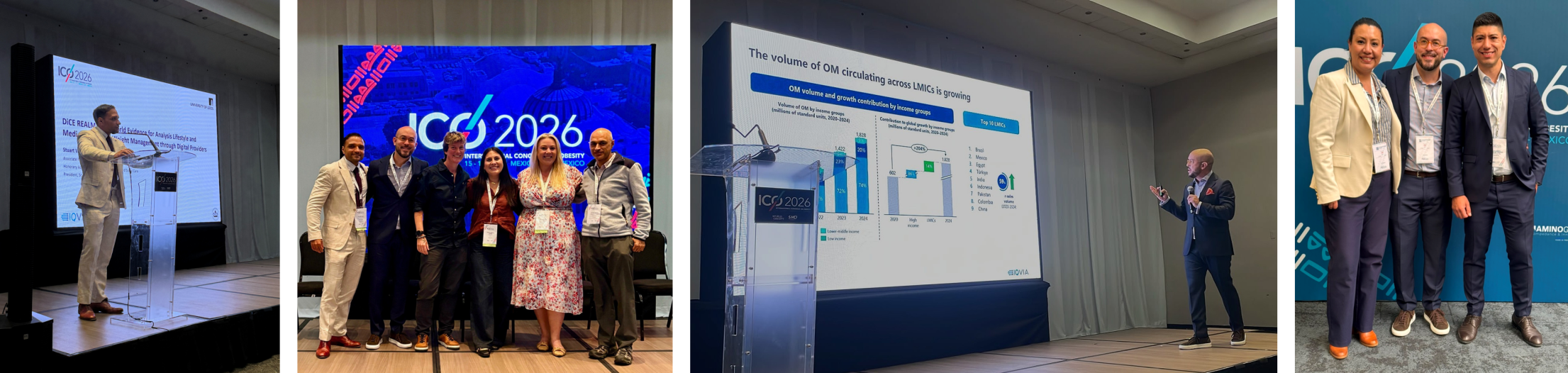
At ICO 2026, IQVIA hosted the symposium “From evidence to practice: Implications for the rollout of medicines for obesity,” showcasing both the DiCE-REALM study and IQVIA’s white paper on obesity medicines in LMICs. The DiCE-REALM study, described as the world’s largest real-world evidence study of medication-supported digital weight management services, demonstrated substantial effectiveness in routine clinical practice in the United Kingdom. The event brought together leading experts in obesity research, policy, and patient advocacy.
ICO 2026 suggested that obesity is entering a new phase. The scientific case for action continues to strengthen, therapeutic innovation is advancing rapidly, and awareness is improving.5 At the same time, the field’s center of gravity is shifting from whether action is possible to how it can be delivered equitably and sustainably through fit-for-purpose health systems.
Integrating obesity into broader NCD strategies, establishing sustainable financing and reimbursement mechanisms, and creating service delivery models that bridge prevention and treatment will all be essential to long-term progress. Market actors must navigate an evolving commercial environment shaped by greater competition and rising expectations around affordability. Most importantly, stakeholders must ensure that scientific progress translates into population-level impact.
The next decade is unlikely to be defined solely by whether obesity medicines work or how many of them are developed. The defining challenge will be whether health systems, markets, and policymakers can build the structures needed to deliver their benefits at scale. What emerged from Mexico City, as an IQVIA takeaway, was a recognition that obesity has entered an implementation era. The conversation is becoming more practical, more system-oriented, and more closely linked to the broader NCD agenda. That may ultimately be the strongest sign that the field is maturing.
References
1 World Obesity Federation (n.d.). International Congress on Obesity (ICO) 2026. Retrieved September 30, 2026, from https://icocongress.com/
2 World Health Organization (2025, December 8). Obesity and overweight. https://www.who.int/news-room/fact-sheets/detail/obesity-and-overweight
3 Rickwood, S., Bonzani, I., and Franks, R. (2025, June 23). Getting real about obesity: The case for obesity registries and how to build them. IQVIA. https://www.iqvia.com/locations/emea/blogs/2025/06/getting-real-about-obesity-the-case-for-obesity-registries-and-how-to-build-them
4 Mora-Brito, D. et al. (2025, September 26). Expanding the toolbox for obesity prevention and treatment in low- and middle-income countries: What does it take to make it happen? IQVIA. IQVIA white paper
5 Meadowcroft, O., Marlow, S., and Rickwood, S. (2026, September 10). Outlook for obesity to 2035. https://www.iqvia.com/locations/emea/blogs/2026/09/outlook-for-obesity-to-2035
Related solutions
Accelerate your obesity trial timelines with solutions designed for rapid execution by leveraging our team of seasoned experts and advanced patient recruitment solutions.
IQVIA is working to advance public health in partnership with other companies, governments, and non-governmental organizations, from fighting opioid addiction to addressing antibiotic resistance.