














Commercial Solutions
Data, AI, and expertise empower Commercial Solutions to optimize strategy, accelerate market access, and maximize brand performance.
This blog is part of the series, A Brave New World: State of the Industry, on modern market dynamics influencing the life sciences industry.
People living in rural geographies experience persistent disparities in health outcomes, and encounter barriers across the care continuum. Rural patients are more likely to die prematurely from five leading causes of death: heart disease, cancer, stroke, chronic lower respiratory disease, and unintentional injuries. Disparities between rural and urban patients are shaped by social, structural, and environmental factors that influence how patients access and navigate care.
Health outcomes remain an essential measure of rural healthcare access, but they often become visible only after patients have experienced barriers to initiating or continuing treatment. For healthcare leaders, that creates a practical challenge: outcomes reveal the consequences of disrupted access but provide limited visibility into where the disruption first occurred.
Patient behavior offers a complementary lens. Measures such as unresolved prior authorization (PA) requirements, delayed prescription fills, abandonment of approved therapies, and treatment continuity can show how access barriers affect the treatment pathway before they appear in long-term outcomes.
Patient behavior can serve as an early indicator of rural healthcare access barriers. Together with administrative outcomes, these signals can show whether disruption is occurring during approval, treatment initiation, affordability, or continued therapy.
Analysis of prescription claims data suggests that rural patients face barriers at multiple stages of the treatment pathway. Compared with metro patients, rural patients are more likely to experience unresolved access issues in the form of utilization management (UM) requirements, longer delays before treatment initiation, higher abandonment when out-of-pocket (OOP) costs increased, and shorter treatment duration in several markets.
Importantly, the divide was not universal. Rural and metro behavior appears similar in primary care markets, while differences emerge in specialty treatment as cost, rejection rates, and treatment complexity create additional friction.
A prescription that is never filled, or a therapy that is discontinued prematurely, can be associated with adverse outcomes for patients and higher costs to the healthcare system. Yet most government and public health reporting focuses on prevalence and utilization. While essential, these measures provide limited visibility into where access is breaking down. Rejection rates, time to fill, abandonment, and time on therapy can help reveal whether coverage is translating into treatment.
One in five Americans lives in a rural area, and at least 20% of patients in every market analyzed abandoned an approved prescription. The level of abandonment is therefore consequential even before rural and metro patterns are compared.
This is a critical moment to measure where rural patients face barriers to treatment. The Rural Health Transformation Program is directing new funding to states, Medicaid policy is changing, and the Medicare Part D out-of-pocket cap is in its second year. Each may affect access for rural patients, creating a need for an early behavioral baseline against which progress can be measured.
Prescription accessibility is governed by many factors outside of individual patient behavior. Access to insurance coverage, and the outcomes attached to that coverage, influences the care patients can receive. Payers apply control levers such as prior authorizations (PA) and step therapies to shape which treatments patients can receive and when.
These controls are widespread. Iin 2025, 70% of commercial and 47% of Medicare Part D attempts to fill a new branded medicine were initially rejected, and in 2024, 24% and 14% of claims, respectively, never gained approval within a year. Coverage protections have not closed the gap: 58% of Medicare attempts in the Part D protected classes were initially rejected in early 2026, and rejection rates for the first drugs selected for Medicare price negotiation were unchanged after their coverage requirement took effect. Even patients who overcome a rejection wait an average of three to five weeks in commercial plans and two to three weeks in Medicare.
These restrictions have consequences beyond the approval process. PA requirements are associated with care delays, disease exacerbation, preventable hospitalization, and lower rates of disease-free survival across specialties including oncology and cardiology. Medicare Advantage insurers alone received nearly 53 million PA requests in 2024. Each unresolved requirement may create another barrier before treatment can begin, and rural prescriptions in the analysis were more likely to remain unresolved.
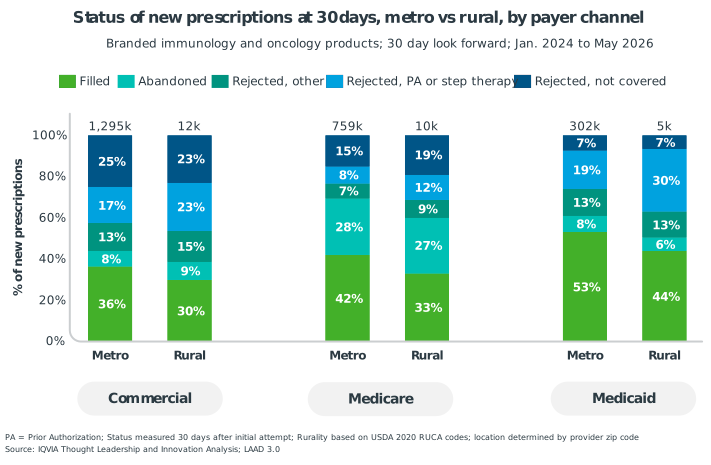
Thirty days after new prescriptions for branded immunology and oncology products were written, fewer rural prescriptions had been filled in every payer channel: 30% versus 36% for metro prescriptions in commercial, 33% versus 42% in Medicare, and 44% versus 53% in Medicaid. Rural fill rates were approximately 17% lower in commercial, 21% lower in Medicare, and 17% lower in Medicaid. The absolute gap was widest in Medicare and Medicaid, where rural fill rates trailed metro rates by nine percentage points.
The largest and most consistent contributors were PA and step therapy requirements. These rejections remained unresolved more often for rural prescriptions in commercial (23% vs. 17%), Medicare (12% vs. 8%), and Medicaid (30% vs. 19%). By contrast, rural and metro patients abandoned prescriptions at similar rates at this stage, pointing to the approval process, rather than abandonment after approval, as the main source of the early gap.
Medicaid is the clearest example. Nearly one in three rural Medicaid prescriptions remained burdened by PAs or step therapy after 30 days, compared with fewer than one in five metro prescriptions. Because Medicaid patients generally face limited pharmacy cost sharing, the pattern is more consistent with an approval process barrier than with OOP cost, although the analysis does not establish the reason the rejections remained unresolved.
These findings reflect only patients able to obtain insurance coverage, and coverage itself differs by geography. Rural residents are more likely to be uninsured and less likely to hold private coverage than urban residents (61.8% vs. 68.0%), while public coverage was overrepresented, held by 45.2% of rural residents compared with 36.1% of urban residents.
A rejected prescription does not necessarily prevent treatment initiation. Prescribers can appeal, resubmit, or switch patients to an alternative therapy, but this process can create meaningful delays. Among patients who filled a new branded immunology or oncology prescription, rural patients waited an average of 18.5 days for a first fill, compared with 14.8 days for metro patients, a difference of 3.7 days, or 25% longer.
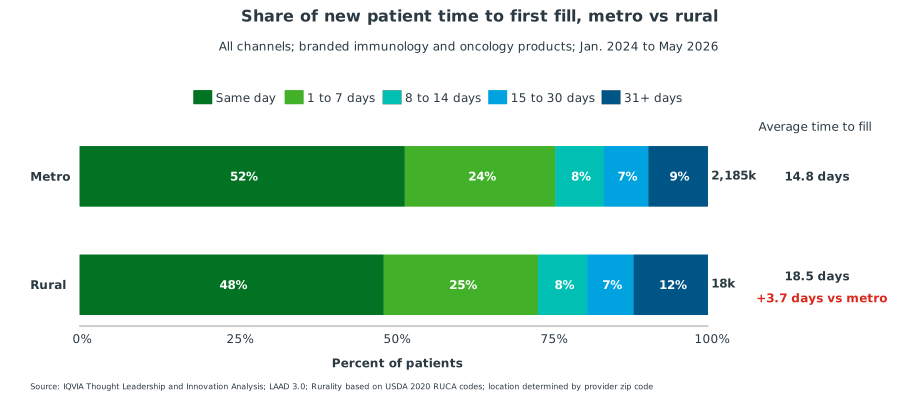
While a 3.7-day difference may not be clinically meaningful on its own, the distribution tells a broader story. Patients facing more unresolved payer rejections were also more likely to face prolonged delays before treatment began.
The difference was concentrated at the two ends of the distribution: fewer rural patients filled on the same day (48% vs. 52%), while more waited longer than a month (12% vs. 9%). Although roughly half of patients started treatment immediately, one in eight rural patients still waited more than 30 days to begin therapy for cancer or an autoimmune disease.
Even after receiving an approval, many prescriptions never reach a fill. Abandonment occurs when a patient does not pick up an approved prescription, and it is often associated with OOP cost.
Among commercially insured patients starting a branded therapy, at least 20% of approved prescriptions were abandoned in every therapy area assessed, in rural and metro areas alike. The gap between rural and metro patients was most pronounced in specialty care, where abandonment reached 25% versus 22% in immunology and 37% versus 26% in oncology, where more than a third of approved rural prescriptions were not filled.
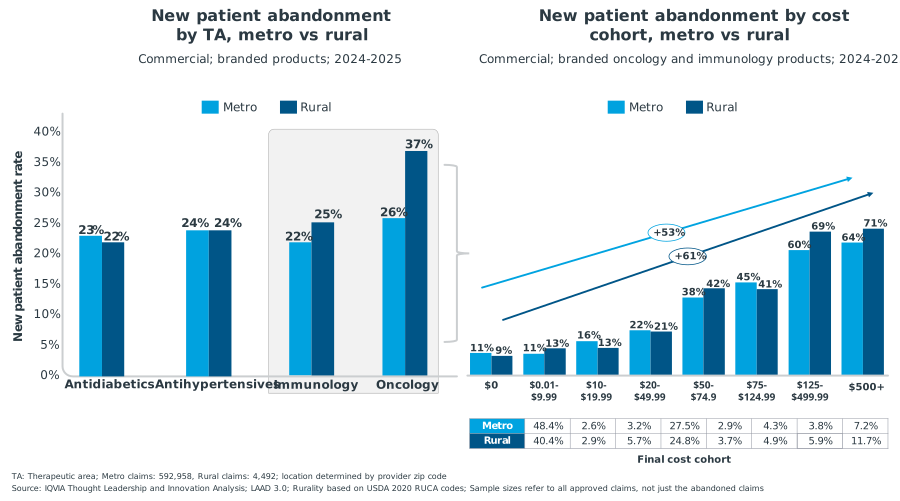
Cost exposure helps explain the pattern. Abandonment increased stepwise as OOP cost rose, and rural patients were more likely to face the highest financial burden.
Rural and metro patients followed the same directional abandonment trend as costs rose, but it was more pronounced for rural patients. They had a 61% increase in abandonment from the $0 cost cohort to the $500+ cohort; for metro patients, this was 53%.
Additionally, rural patients were less likely to reach a $0 final cost (40% vs. 48%) and more likely to face a substantial OOP expense, with 12% paying $500 or more compared with 7% of metro patients. Further studies should assess awareness of copay assistance, practice capacity to support enrollment, and deductible timing. Regardless of the mechanism, affordability is one of the most practical points at which to intervene.
Medicare Part D reform provides a useful example of what happened as patient cost exposure changed. The 5% coinsurance requirement in the catastrophic phase ended in 2024, and a $2,000 annual cap on OOP spending took effect in 2025. Studying the impact of legislation by geography shows whether a policy change is reaching rural and metro patients equally.
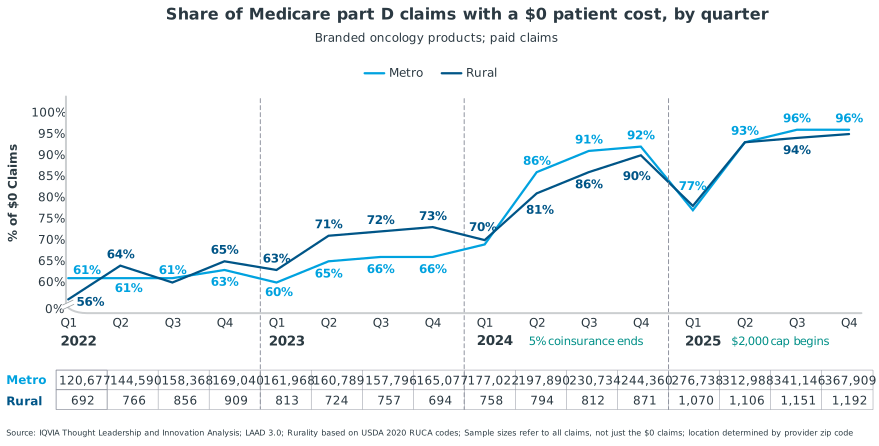
Among paid Part D claims for branded oncology products, the share with a $0 patient cost varied considerably before the reforms, ranging from 56% to 73%. The share of claims with $0 patient cost was lower at the beginning of each year, when Part D deductibles reset and patients began accumulating OOP spending again. By the end of 2025, nearly all of these paid claims carried no OOP cost for both rural and metro patients. The analysis does not include rejected or abandoned claims.
The timing and magnitude of the increase are consistent with the Part D reforms reducing OOP costs among paid claims across geographies. Because the policy changes were built into the benefit design, patients did not need to enroll in a separate assistance program or navigate additional administrative steps. Among the claims observed, rural patients reached a $0 cost at nearly the same rate as metro patients.
Filling a prescription is only the first step. It is important to measure treatment continuity to understand whether patients stay on the therapy they started. Here, continuity is measured as the average number of therapy days supplied during the 365 days following a patient’s first fill.
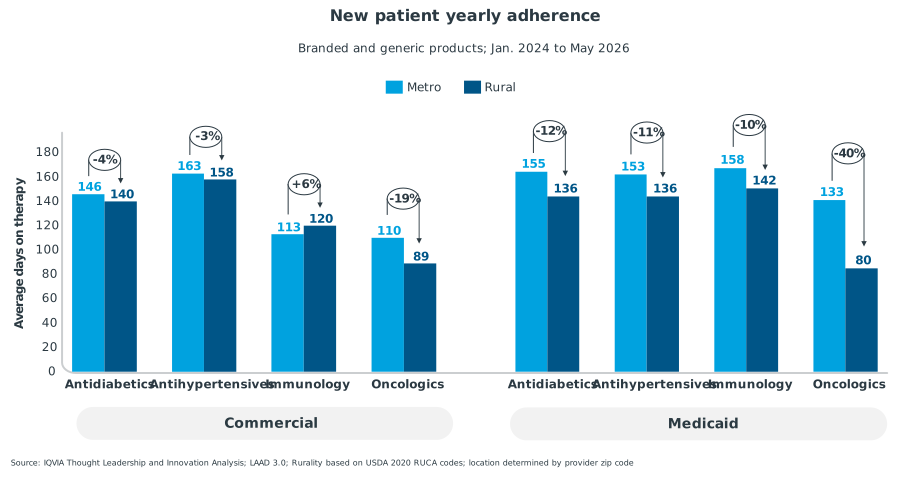
For commercially insured patients, rural and metro time on therapy was similar in antidiabetics (140 vs. 146 days), antihypertensives (158 vs. 163 days), and immunology (120 vs. 113 days). Oncology was the exception, with rural patients averaging 89 days on therapy compared with 110 days for metro patients, roughly three weeks fewer.
Medicaid showed a different pattern. Rural patients had fewer days on therapy in every therapeutic area, with gaps of 10% to 12% in antidiabetics, antihypertensives, and immunology, reaching a 40% difference in oncology. Rural Medicaid oncology patients averaged just 80 days on therapy in their first year, compared with 133 days for metro Medicaid patients.
Payer channel alone does not account for the observed pattern. In metro areas, Medicaid patients remained on therapy longer than commercial patients in three of the four markets. In rural areas, that relationship reversed. The sharpest disparity emerged where rural geography and Medicaid coverage intersected, particularly in oncology.
Potential contributors for further study include reauthorization requirements, eligibility disruptions, and access to pharmacies or follow-up care. The current analysis does not determine the contribution of each factor, but these findings provide an important baseline as Medicaid policy changes move forward.
Health outcomes remain essential measures of rural disparity, but they often reflect barriers that patients have already encountered. Abandonment, unresolved rejections, treatment delays, and gaps in treatment continuity provide earlier visibility into where coverage is failing to translate into timely and sustained treatment.
No single measure can explain why access breaks down. Examined together, however, these signals can help identify where friction emerges across the treatment journey, whether during affordability, utilization management, treatment initiation, or continuity. They can also distinguish barriers that require different interventions rather than treating rural access as a single problem.
That visibility can support a more specific response:
How these measures are applied will vary across stakeholders. Government and public health organizations can use treatment-journey measures to evaluate whether programs and policy changes translate into treatment. Manufacturers can identify where affordability, administrative, or continuity barriers arise and align support with demonstrated need. Providers and health systems can use rejection and delay patterns to identify opportunities to strengthen patient navigation. Payers can examine whether formulary and PA / step therapy requirements are associated with different access outcomes across geographies. The appropriate response depends on where the disruption occurs; approval support, affordability assistance, and continuity interventions address different points in the journey.
Rural disparities should not be studied only after they appear in outcomes. Earlier signals already exist across the treatment journey. Coverage creates the opportunity for treatment; patient behavior and administrative outcomes reveal whether that possibility becomes timely and sustained care. Measured together, those signals can show whether the more immediate need is approval support, affordability, treatment initiation, or continuity, allowing the response to follow the barrier patients are encountering.
To learn how treatment journey signals can help identify and address rural access barriers, contact your IQVIA representative.

Related solutions
Data, AI, and expertise empower Commercial Solutions to optimize strategy, accelerate market access, and maximize brand performance.
Gain high value access and increase the profitability of your brands
Improve healthcare for all with actionable insights and predictive analytics
Leapfrog the competition by proving the value of your products