





.svg)











Stay ahead with the EMEA Thought Leadership insights: your source for industry-leading expertise and analysis
Blog
Personas and Precision: Optimising HCP Engagement across the Life Sciences Industry
Oct 16, 2026
The rapid expansion of digital and remote engagement channels has fundamentally reshaped how healthcare professionals (HCPs) interact with pharmaceutical companies. This transformation is accelerating, driven in part by the growing adoption of artificial intelligence (AI) into clinical practice: 80% of HCPs have now adopted AI tools and 49% use them multiple times a week, according to a large IQVIA study.1 As HCPs embrace new technologies and information sources, their expectations of industry engagement continue to evolve. To remain effective, commercial strategies must evolve in parallel.
Historically, pharmaceutical companies have adapted to these changes with varying degrees of success, often looking to competitors for cues on best practice. However, the organisations best positioned to succeed are those with the deepest understanding of HCP behaviours, needs, and preferences. This allows companies to better prioritise target audiences, optimise channel strategy, and allocate resources where they will have the greatest impact.
Persona-based segmentation offers a powerful lens through which to understand the engagement landscape. It provides a more precise and actionable view than broad, country-level averages, while retaining the scalability that individual HCP profiling cannot deliver. By grouping physicians according to shared behaviours and preferences, life sciences organisations can make interactions more relevant and enhance the effectiveness of their commercial engagement strategies.
A critical first step is determining which HCPs to prioritise. This requires understanding how different physicians adopt innovation, particularly in the context of a new product launch. In this analysis, HCPs are classified into three adoption personas: Innovators and Early Adopters, Early Majority, and Late Majority and Laggards.
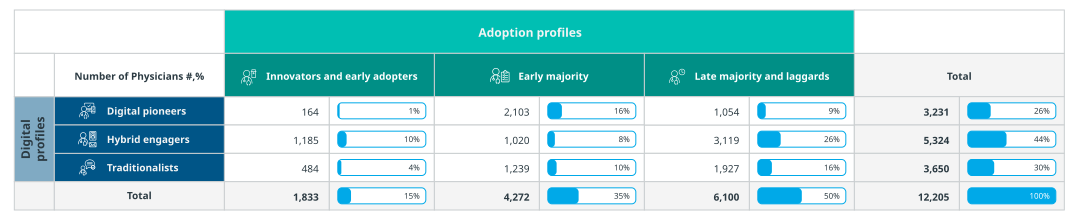
For example, IQVIA's OneKey HCP population data estimates that there are 12,205 oncologists in the UK, of whom 1,833 fall within the Innovators and Early Adopters segment (Figure 1). Such insights enable organisations to align field force deployment and commercial investment more effectively across countries, specialties, and practice settings. Importantly, engagement priorities should evolve throughout a product's lifecycle, beginning with Innovators and Early Adopters around launch before progressively expanding to later-adopting segments.
Figure 1: Number of oncologists by persona in the UK
Source: IQVIA Persona Intelligence
As well as understanding which HCPs to engage, organisations must determine how best to engage them. To support this, HCPs can be segmented according to their preferred balance of digital and traditional engagement channels. In this analysis, three digital personas are used: Digital Pioneers, who favour predominantly digital interactions; Traditionalists, who prefer in-person engagement; and Hybrid Engagers, who value a combination of both. The following analysis focuses on Digital Pioneers and Traditionalists as two contrasting ends of the spectrum.
Figure 2 benchmarks conversion rates in Germany among the twelve innovative pharmaceutical companies with greatest interaction volume, comparing performance across these persona types. Conversion represents one of the most meaningful indicators of engagement effectiveness, and is defined as an HCP reporting an intention to either increase prescribing, or maintain an already high level of prescribing. To provide additional context, the analysis also includes average and top-decile conversion benchmarks calculated across the top 100 companies in scope.
Figure 2: Company conversion rates and benchmarks for Germany (MAT Q1 2026)
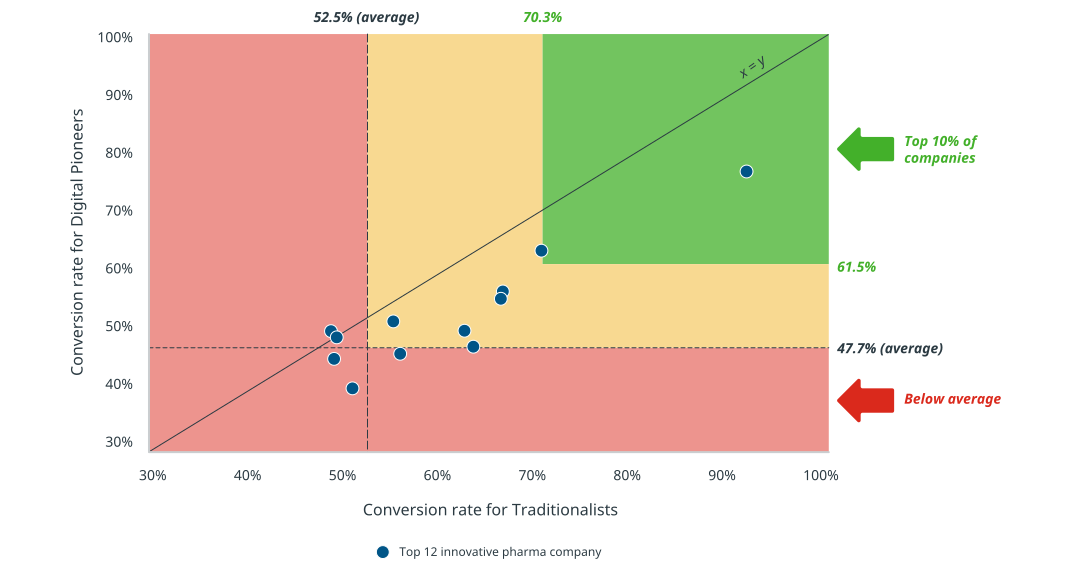
Notes: Overall scope includes the top 100 companies based on total interaction volume in Germany for MAT Q1 2026. The chart shows the top 12 innovative companies within this cohort, excluding generic manufacturers. Average and top 10% conversion rates are calculated across all 100 companies. Top 10% performance is based on company ranking by conversion rate for the relevant persona.
Source: IQVIA Persona Intelligence
The findings reveal a consistent pattern: all but one of the twelve companies achieved higher conversion rates among Traditionalists than among Digital Pioneers, often by a considerable margin. Across all 100 companies, average conversion reached 53% for Traditionalists compared to 48% for Digital Pioneers. This performance gap suggests that industry is not yet engaging digitally oriented HCPs as effectively as those who prefer in-person engagement. Notably, top-decile conversion thresholds were 70% for Traditionalists and 62% for Digital Pioneers, indicating that the disparity becomes even more pronounced among top-performing organisations.
One company emerged as a clear outlier, achieving conversion rates of 92% and 77% respectively. For both personas, its engagement approach incorporated a relatively high proportion of face-to-face (F2F) one-to-one interactions and limited use of postal mail compared to other organisations. Conversion performance was strong across channels, suggesting that success was driven not only by channel selection but also by the quality and relevance of the messaging delivered. More broadly, these results demonstrate that conversion rates approaching 90% are achievable and highlight the considerable opportunity for many organisations to improve engagement effectiveness, particularly among Digital Pioneers.
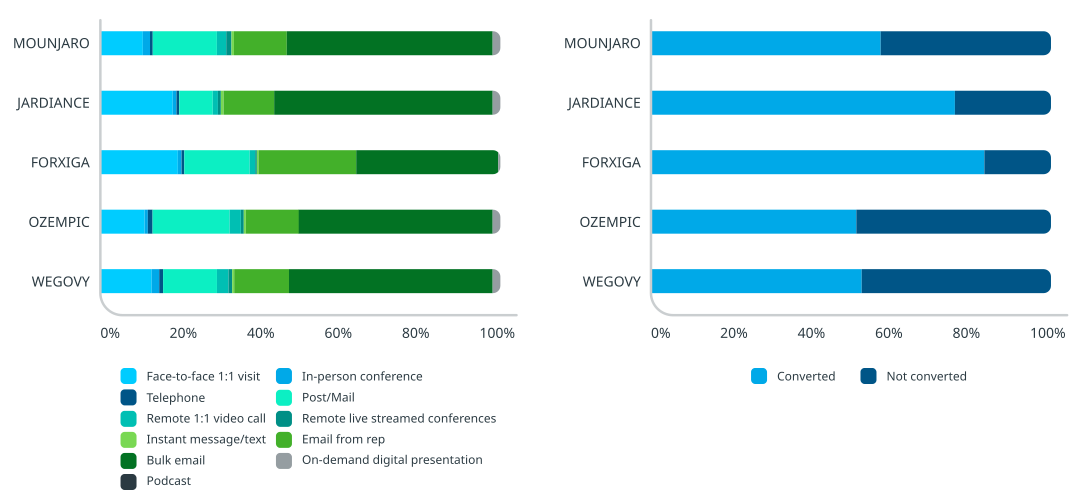
Channel strategy becomes even more nuanced at the brand level. Figure 3 illustrates engagement activity directed towards Digital Pioneers for the five diabetes and weight management therapies with highest promotional volume in the EU4 and UK, which include both SGLT2s and GLP-1s. The context of the engagement differs between these as most patients who are prescribed Wegovy, or Mounjaro for obesity, are not publicly reimbursed, and patient awareness of GLP-1 brands is generally very high. The purpose of Figure 3 is not to directly compare these brands but rather to show how channel mix can vary. Across all brands, the dominant channels included F2F one-to-one visits, postal mail, representative-led email communications, and bulk email campaigns, with varying levels of emphasis. Additional channels, including in-person conferences and remote one-to-one video calls, were utilised to a lesser extent.
Figure 3: Channel mix and conversion rates for Digital Pioneers (selected diabetes and weight management brands, EU4 & UK, MAT Q1 2026)
Source: IQVIA Persona Intelligence
Conversion performance varied significantly. Forxiga achieved the highest conversion rate at 84%, followed by Jardiance at 76%, substantially above the other three brands, where conversion rates ranged between 50% and 60%. Both Forxiga and Jardiance employed a relatively high proportion of F2F interactions, and Forxiga combined this with the lowest reliance on bulk email and the highest use of representative-led email communications. Although the analysis does not establish causality, these patterns align with previous IQVIA Thought Leadership findings. Firstly, F2F engagement remains highly valuable even among digitally inclined HCPs, albeit as part of a more digital channel mix. Secondly, personalised communications from representatives appear to be more impactful than broad, low-cost email campaigns.
Alongside conversion, additional key performance indicators (KPIs), such as Net Promoter Score (NPS), provide further insight into engagement quality and competitive positioning. As shown in Figure 4, Forxiga not only achieved high conversion but also a strong NPS, as did Ozempic and Wegovy, suggesting that HCPs consistently valued these interactions highly. Once again, Forxiga distinguished itself through lower reliance on digital channels than the other brands, and high use of personal channels*, reinforcing the trends observed in Figure 3.
*Personal channels include: F2F 1:1 visits, remote 1:1 video call, telephone call, instant messages / texts, emails sent directly from representatives.
Figure 4: KPIs for Digital Pioneers (selected diabetes and weight management brands, EU4 & UK, MAT Q2 2026)
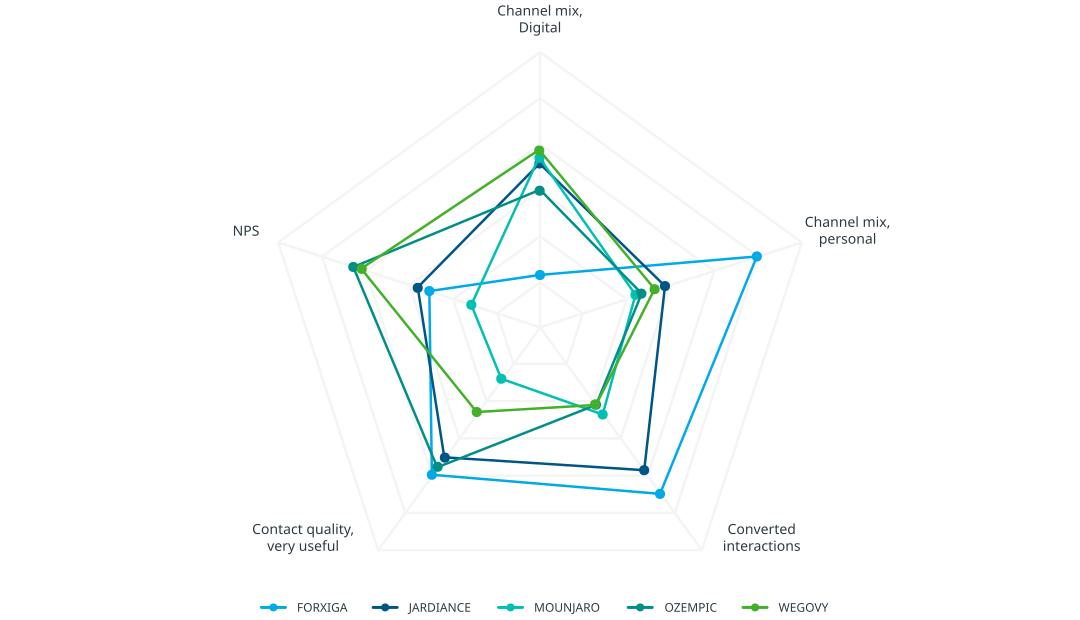
Note: Each axis is scaled relative to the values for the brands displayed. NPS measures interaction quality depending on an HCP’s likelihood to recommend the interaction to a colleague; contact quality reflects how useful the interaction is to that HCP’s clinical practice; and channel mix (digital or personal) represents the percentage of total engagement volume delivered through the corresponding channels (digital or personal respectively).
Source: IQVIA Persona Intelligence
A useful way to refine channel strategy is to compare the delivered engagement mix to HCPs’ stated preferences. Figure 5 presents this comparison for two next-generation GLP-1 therapies across four high-priority specialties. While overall activity broadly reflected HCP preferences, notable discrepancies emerged. Bulk email communications were consistently over-utilised, whereas in-person conferences were under-utilised. Engagement preferences vary not only by specialty and geography but also by persona, and therefore by aligning activity more closely with the preferences of specific HCP groups, organisations can improve the relevance and effectiveness of their engagement.
Figure 5: Activity versus preference for two next-generation GLP-1 therapies across four specialties (EU4 & UK, MAT Q2 2026)

Note: The four specialties included are those with the highest contact volume for these brands across the countries analysed: General Practitioners, Cardiologists, Diabetologists/Endocrinologists, and Internists.
Source: IQVIA Persona Intelligence
Conclusion
In an increasingly fragmented engagement environment, persona-based segmentation provides the precision and scalability required to optimise commercial strategy. By examining differences across countries, specialties, brands, and HCP groups, organisations can uncover meaningful variations in engagement preferences, behavioural patterns, and conversion potential. These insights translate directly into more informed commercial decisions, whether that means increasing field force investment in markets with a strong preference for face-to-face engagement or adopting a more digitally led approach where audiences are more receptive to remote interactions.
Competitive benchmarking adds another valuable dimension, enabling companies to identify which engagement strategies resonate most strongly with specific HCP segments and where opportunities for differentiation exist.
Ultimately, commercial success depends on reaching the right HCPs, through the right channels, at the right time. Persona-level insights help organisations to continuously refine their approach based on evidence. The analysis for Germany illustrates the scale of the opportunity: average conversion rates were 53% among Traditionalists and 48% among Digital Pioneers, while one leading company achieved conversion rates of 92% and 77% respectively. Organisations that translate these insights into action will be best positioned to strengthen customer relationships, improve commercial performance, and thrive in an increasingly dynamic healthcare landscape.
Understanding HCP personas
Discover how persona-based segmentation can inform more relevant HCP engagement across the product lifecycle.
Persona-based segmentation groups healthcare professionals (HCPs) by shared behaviours and preferences. IQVIA's Persona Intelligence defines two sets of personas: adoption personas, which reflect how quickly HCPs take up new treatments, and digital personas, which are based on preferred engagement channels.
Persona-based segmentation provides a more precise and actionable view than country-level averages, while being more scalable than individual HCP profiling. Life sciences organisations leverage this to make their HCP engagement more relevant and effective.
At launch, companies should focus first on HCPs who are Innovators and Early Adopters. Over the product's lifecycle, they can then extend engagement to later-adopting groups.
Not yet, based on IQVIA Persona Intelligence data for Germany. Across the top 100 companies, average conversion was 48% among Digital Pioneers, compared to 53% among Traditionalists. Conversion means an HCP intends to increase prescribing or keep it at an already high level.
References:
1IQVIA Use of AI Tools ChannelDynamics Survey, May-July 2026; survey base: n = 23,769 HCPs across 34 markets; each HCP classified by highest usage frequency of any AI tool