High blood pressure affects 1.4 billion people globally. It is the number one risk factor for all-cause mortality, for example leading to ischaemic heart disease, heart failure, stroke, chronic kidney disease or dementia. In 2023, 11 million deaths were attributed to hypertension, or 16% of all deaths worldwide [1, 2]. Crucially, hypertension is a preventable risk thus making sustained blood pressure control, at population level, a public health priority to prevent millions of avoidable, premature deaths.
However, optimal blood pressure control remains elusive for many patients. Achieving effective prevention and control of hypertension requires pharmacotherapeutic innovation combined with a supportive policy environment and targeted efforts that address systemic barriers along the patient journey.

Hypertension innovation landscape
The current hypertension pipeline, excluding pulmonary hypertension, comprises 116 clinical-stage assets, including 44 in phase 1, 25 in phase 2, 34 in phase 3 and 13 at pre-registration. Combination therapies account for 20% of the hypertension pipeline, with many of those exploring new fixed-dose combinations (FDCs) of multiple, often off-patent actives.
These innovation efforts explore a range of mechanisms of action and modalities to target both well-established and emerging pathways associated with hypertension.
The Renin–Angiotensin–Aldosterone System (RAAS), as the primary regulator of blood volume, electrolyte homeostasis and systemic vascular resistance, has been the principal target of existing, foundational anti-hypertensive drugs, including beta blockers, renin inhibitors, angiotensin converting enzyme (ACE) inhibitors, and angiotensin II type receptor blockers (ARBs).
Novel therapeutic approaches seek to improve on legacy, RAAS-mediating drugs through greater precision, selectivity and extended durability to address unmet needs, e.g., uncontrolled, resistant hypertension or primary aldosteronism.
-
By directly targeting CYP11B2, the enzyme responsible for aldosterone synthesis, highly selective aldosterone synthase inhibitors (ASI), such as baxdrostat, lorundrostat, dexfadrostat phosphate, hold great promise for treating uncontrolled or resistant hypertension, and primary aldosteronism. For example, AstraZeneca’s baxdrostat, recently approved by the FDA as Baxfendy, reduced systolic blood pressure (SBP) at week 12 by 9.8 mmHg (placebo-adjusted) in the BaxHTN phase 3 trial, while demonstrating the ability to control ambulatory SBP over a 24-hour period in patients with treatment-resistant hypertension in the phase 3 Bax24 study [3-5].
-
Non-steroidal mineralocorticoid receptor antagonists (nrMRA) seek improved selectivity and safety over older steroidal MRAs such as spironolactone. Non-steroidal MRA esaxerenone is approved for hypertension treatment in Japan and has demonstrated potent and sustained antihypertensive effects in different patient populations, including those with moderate renal impairment, type 2 diabetes with albuminuria and severe hypertension [6]. Bayer’s nrMRA finerenone, approved as Kerendia for CKD and heart failure, offers modest SBP reduction but significant broader cardiorenal protection, in particular for patients with diabetes and chronic kidney disease.
-
Hepatic angiotensinogen (AGT) inhibition represents an upstream intervention in RAAS to block the downstream signalling cascades triggered by angiotensin type 1 (AT1) and type 2 (AT2) receptors. Subcutaneous, small interfering RNA (siRNA) zilebesiran (Roche/Alnylam), with 6-monthly dosing, achieved durable suppression of serum AGT and reduced 24-hour ambulatory SBP by 15 mmHg vs. placebo after 3 months in the KARDIA-1 phase 2 trial. The anti-hypertensive effect was sustained over 6 months following a single injection. Zilebesiran has progressed to phase 3, with the ZENITH global cardiovascular outcomes trial (CVOT) enrolling 11,000 patients with uncontrolled hypertension [7].
An alternative approach utilising antisense oligonucleotides (ASOs) targets mRNA to inhibit the translation of AGT protein. In the KARDINAL phase 2 trial, ASO therapeutic tonlamarsen (Ionis/Kardigan) demonstrated a statistically significant reduction in plasma AGT levels and a clinically meaningful reduction in in-office SBP from baseline to week 20 [8]. A phase 2b trial investigating tonlamarsen in patients with acute severe hypertension (ASH) is expected to start later in 2026.
Looking beyond RAAS, endothelin-1 is a potent vasoconstrictor that acts on two receptors, type A (ETA) and type B (ETB), and plays a key role in the pathogenesis of hypertension, thus making it another promising therapeutic target. Idorsia’s dual ETA/ETB receptor antagonist aprocitentan is approved for the treatment of resistant hypertension. In the phase 3 PRECISION trial, a 25mg dose reduced office SBP by 15.2 mm Hg in resistant hypertension, which was sustained through 40 weeks [9].
Atrial natriuretic peptide is involved in the long-term regulation of sodium and water balance, blood volume and arterial pressure [10]. However, short half-life has limited therapeutic applications to date. Instead, augmentation of the natriuretic peptide system by inhibiting neprilysin, a key enzyme for degradation, has proven effective in lowering blood pressure. For example, Entresto, a fixed dose combination of neprilysin inhibitor sacubitril and ARB valsartan, demonstrated a significant antihypertensive effect over ARB olmesartan, including a superior, sustained blood-pressure-lowering effect over 24 hours. Entresto is approved for the treatment of hypertension in China, Japan and South Korea [11, 12].
Other exploratory MoAs in preclinical or early-stage development include aminopeptidase A inhibitors, AT2 receptor agonists, ACE2 activators, angiotensin-(1-7) analogues and nicotinamide adenine dinucleotide (NAD+) supplementation [6].
The role of inflammation, immunity and oxidative stress in the initiation and evolution of hypertension is increasingly being recognised, which opens the door for potential novel therapeutic strategies [13].
Beyond the development of de novo pharmacotherapies, some companies look to fixed-dose combinations (FDC) of multiple, typically established antihypertensive agents to reduce the pill burden on patients with the aim to improve adherence and persistence. For example, Servier is developing triple- and quadruple-combinations in a single pill, including a beta blocker, ACE inhibitor, calcium channel blocker with or without a diuretic [14].
Controlling hypertension: beyond pharmacotherapeutic innovation
Despite the availability of long-established, now off-patent antihypertensive therapies, and the emergence of novel therapeutic options, elevated blood pressure remains a major health burden in both developed and developing countries.
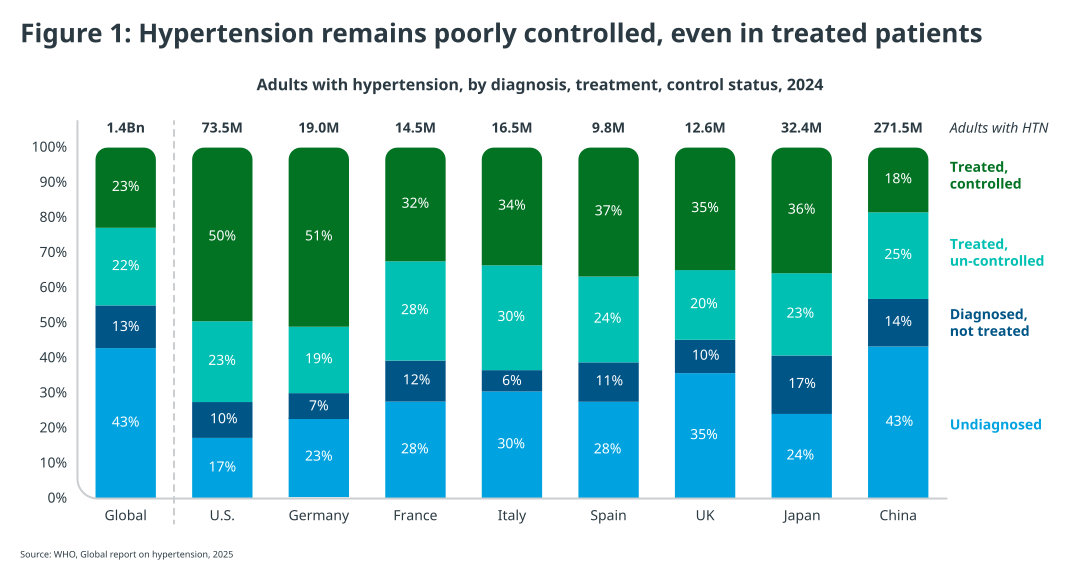
Global blood pressure control rates are still disconcertingly low, at ~23% of adults affected by hypertension, and only up to ~50% even for those being treated. Among high-income countries, very few achieve control rates of 50% for their respective hypertensive adult populations, while many find themselves around the 35% mark (see Figure 1)[1].