
.svg)




Defensible Data & AI
Secure your platforms and products to drive insights from AI and accelerate healthcare transformation.












Distill and compress patient data enough that it can't be reconstructed, and the usual assumption is that you've done away with the signal too. That assumption turns out to be testable. And, at least for disease prediction, that assumption is wrong.
We trained disease risk models on compressed latent representations of claims data, never on the records themselves, and asked whether they could still identify patients with a common chronic condition and a rare, hard-to-diagnose cancer. They could. Below we describe what we found, where we think it applies in patient analytics and research, how the method works, and what it has not yet proven.
The obvious objection to lossy compression is that you throw away the signal you're looking for, so we tested it directly. A U.S. claims database and a social-determinants database were held in segregated environments and joined securely only as trends. Two outcomes were chosen: type 2 diabetes, common at roughly 12% prevalence, and pancreatic cancer, rare at roughly 1.7% lifetime risk. Gradient-boosted trees were trained on the trends alone, with minimal task-specific feature engineering, under stratified 10-fold cross-validation on approximately 1.4 million individuals. Outcomes were defined from curated clinical code sets rather than adjudicated chart review, a limitation we return to below.
Both models discriminated well, with AUROC over 93% for both type 2 diabetes and for pancreatic cancer. But AUROC can be misleading under low prevalence, because a large true-negative pool inflates specificity. The more honest benchmark is area under the precision–recall and comparing against the prevalence-based no-skill baseline.1 The diabetes model achieved a PR-AUC of 74%, against a no-skill baseline equal to the cohort prevalence of about 11%. For pancreatic cancer, at a cohort prevalence under 0.1%, PR-AUC was 22%, and nearly 60% of all cases fell within the top 1% of ranked predictions (see Table 1). Fold-improvements over the prevalence baseline are large but inflate mechanically as prevalence falls, so the operating points are the more meaningful figures. These models were trained on claims activity concurrent to the outcome definition. Characterising how far in advance the signal emerges is a separate question, and one we're taking up next.2 Rare-disease case-finding is precisely where privacy-preserving methods are most needed and hardest to deliver.
Table 1: Precision and recall at population thresholds.
|
Population Threshold |
K |
Precision@K |
Recall@K |
|
Pancreatic Cancer |
|||
|
1.00% |
13,909 |
5.10% |
59.83% |
|
2.00% |
27,818 |
2.87% |
67.34% |
|
3.00% |
41,727 |
2.04% |
71.81% |
|
5.00% |
69,546 |
1.33% |
77.89% |
|
10.00% |
139,092 |
0.73% |
85.57% |
|
Type 2 Diabetes |
|||
|
1.00% |
13,909 |
94.00% |
8.63% |
|
2.00% |
27,818 |
92.49% |
16.98% |
|
3.00% |
41,727 |
91.06% |
25.07% |
|
5.00% |
69,546 |
87.25% |
40.04% |
|
10.00% |
139,092 |
73.05% |
67.05% |
A model that performs this well on pancreatic cancer without ever touching a patient record changes what’s feasible in settings where data access, not method, is the binding constraint.
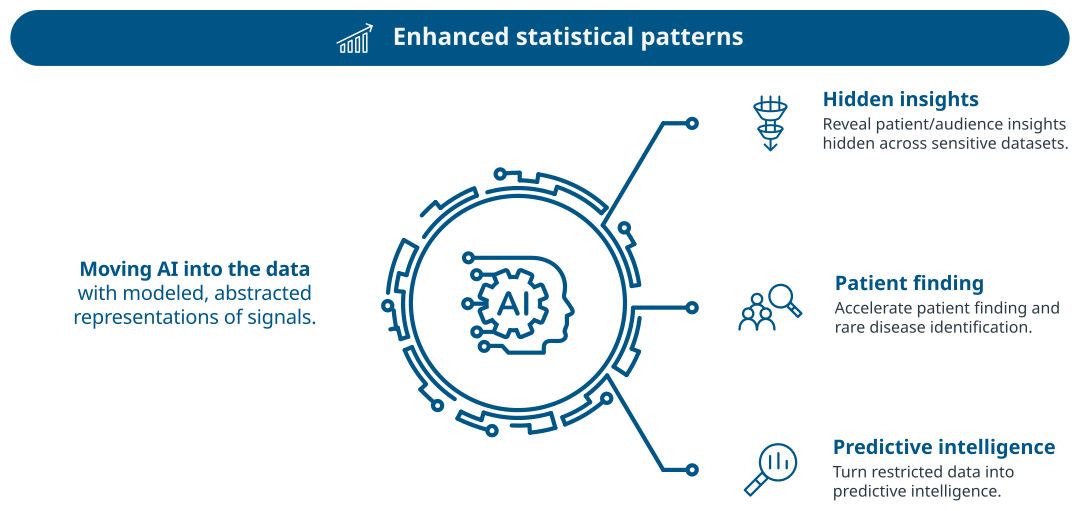
The reason these results hold is that the distillation and compression step is the pipeline. Built in the IQVIA Synthetic Trends Engine,4 the approach rests on four principles:
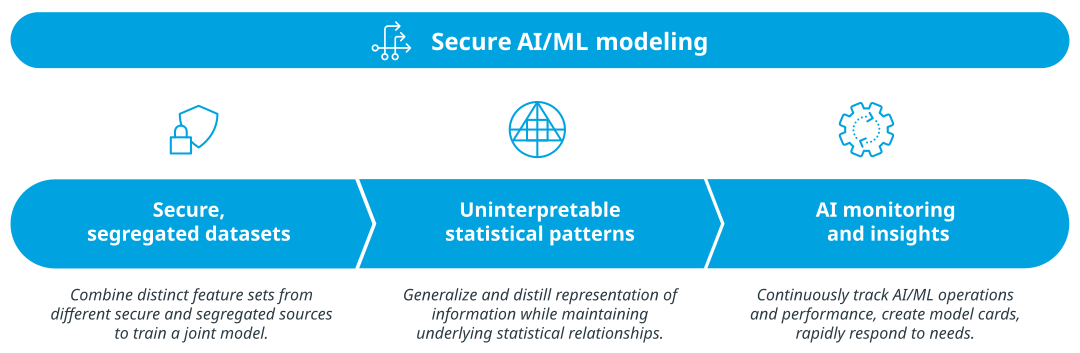
Before the disease-prediction work, the engine was deployed at scale for IQVIA Digital in a setting with competitive bake-offs against other vendors, independently benchmarked. Federated Audience Modeling (FAM), launched in July 2025, is the methodology that won a PM360 innovation award for creating IQVIA Digital Consumer Modeled Audiences.10,11
A global pharmaceutical brand needed to connect with the right consumers to drive doctor visits and new‑to‑brand prescription (NBRx) starts for a women's health product. In a bake‑off against other leading vendors, it built two consumer segments: women with a diagnosis for the condition of interest, and women with that diagnosis plus additional risk factors.
IQVIA Digital met the minimum audience‑size requirements for both segments from the outset, then introduced FAM partway through the campaign and rebuilt optimized versions of both audiences. This enabled a direct benchmark against their predecessors. Measured audience quality (a precision score) rose by 81% on average versus the prior methodology (79% for the diagnosed‑condition segment and 83% for the diagnosed‑plus‑risk‑factors segment), with a better cost‑per‑target‑reached and the highest efficiency ratings among all vendors in the bake‑off.12
In a collaboration with VDX.tv, a global pharmaceutical brand extended linear TV campaigns into digital video across desktop and mobile for its oncology and rheumatology brands, validating performance against other data providers through independent, third‑party benchmarking.
IQVIA Digital Consumer Modeled Audiences are built on comprehensive health data (claims, diagnoses, procedures, and prescriptions) and applied FAM to surface the consumers most likely to respond. The independently benchmarked result: 2x the audience quality (a precision score) on the oncology brand and 20% higher audience quality on the rheumatology brand versus the next‑best vendor.13
The methodology is transparent. We publish our FAM methodology, submit it to Expert Determination, deliver auditable proof of metrics that are used in a model card produced with every audience, and subject our practices to an Ethics Board structured much like the governance bodies used in clinical trials.
The framework is assessed against established adversarial threat models for predictive AI, such as membership inference (determining whether a specific individual was in the training set), model inversion (reconstructing plausible inputs from a trained model), and reconstruction attacks against embeddings and gradients.14,15,16 Operating exclusively on compressed latent representations reduces the attack surface for each of these threats relative to gradient-federated alternatives. Reconstruction risk and model inversion are measured, not assumed. They are precursors to re-identification risk, since an adversary can only identify what they can first uncover.
The feasibility work had limitations, but it’s an ongoing effort. It was conducted across segregated environments under a single custodian, so it demonstrates latent-space federation rather than cross-institutional federation across independent health systems. Prospective multi-site replication could be a next step. Outcomes were ascertained from claims codes and are subject to coding artefacts, without gold-standard clinical adjudication. And while the architecture composes with formal privacy guarantees (eg, differential privacy can be applied at various steps) empirical characterisation of the resulting privacy–utility balance still needs to be evaluated.
Distillation and compression that prevents reconstruction and model inversion doesn't have to come at the cost of insight. Two disease-prediction tasks show the signal survives the compression. Commercial deployment at scale shows the architecture holds up under independent scrutiny. We've been equally specific about what remains unproven. For research questions where data access rather than method is the binding constraint, that’s what makes the difference between a study you can design and one you can run. The interesting conversations start with what a specific data environment makes possible.
1 Saito T, Rehmsmeier M. The precision-recall plot is more informative than the ROC plot when evaluating binary classifiers on imbalanced datasets. PLOS ONE. 2015;10(3):e0118432. https://doi.org/10.1371/journal.pone.0118432
2 Placido, D., Yuan, B., Hjaltelin, J.X. et al. A deep learning algorithm to predict risk of pancreatic cancer from disease trajectories. Nat Med 29, 1113–1122 (2023). https://doi.org/10.1038/s41591-023-02332-5
3 Mishra AK, Chong B, Arunachalam SP, Oberg AL, Majumder S. Machine learning models for pancreatic cancer risk prediction using electronic health record data — a systematic review and assessment. Am J Gastroenterol. 2024;119(8):1466–82. https://doi.org/10.14309/ajg.0000000000002870
4 IQVIA. Trustworthy AI/ML for patient analytics and research Internet. IQVIA; 2026 Jan 7. https://www.iqvia.com/library/white-papers/trustworthy-ai-ml-for-patient-analytics-and-research
5 Si Y, Du J, Li Z, Jiang X, Miller T, Wang F, et al. Deep representation learning of patient data from Electronic Health Records (EHR): a systematic review. J Biomed Inform. 2021;115:103671. https://doi.org/10.1016/j.jbi.2020.103671
6 Lee YC, Jung SH, Kumar A, Shim I, Song M, Kim MS, et al. ICD2Vec: mathematical representation of diseases. J Biomed Inform. 2023;141:104361. https://doi.org/10.1016/j.jbi.2023.104361
7 Rieke N, Hancox J, Li W, Milletarì F, Roth HR, Albarqouni S, et al. The future of digital health with federated learning. npj Digit Med. 2020;3:119. https://doi.org/10.1038/s41746-020-00323-1
8 Kaissis GA, Makowski MR, Rückert D, Braren RF. Secure, privacy-preserving and federated machine learning in medical imaging. Nat Mach Intell. 2020;2(6):305–11. https://doi.org/10.1038/s42256-020-0186-1
9 Stadler T, Oprisanu B, Troncoso C. Synthetic data – anonymisation groundhog day. In: 31st USENIX Security Symposium; 2022. p. 1451–68. https://www.usenix.org/conference/usenixsecurity22/presentation/stadler
10 IQVIA Digital. Setting a New Standard: More Effective, Safer Consumer Audiences for Healthcare Marketers Internet. IQVIA Digital; 2025 Aug 20. https://www.iqviadigital.com/resources/blogs/setting-a-new-standard-more-effective-safer-consumer-audiences-for-healthcare-marketers
11 PM360. PM360 2025 Innovative Marketing Technology or Services: IQVIA Digital Consumer Modeled Audiences Internet. PM360; 2025 Dec 22. https://pm360online.com/pm360-2025-innovative-marketing-technology-or-services-iqvia-digital-consumer-modeled-audiences/
12 IQVIA Digital. Women's health brand increases ad campaign performance Internet. IQVIA Digital; 2025 Sep 9. https://www.iqviadigital.com/resources/case-studies/womens-health-brand-increases-ad-campaign-performance
13 IQVIA Digital. IQVIA Digital Consumer Modeled Audiences outperformed other providers by significant margins Internet. IQVIA Digital; 2026 Jun 17. https://www.iqviadigital.com/resources/case-studies/consumer-modeled-audiences-outperformed-other-providers
14 Shokri R, Stronati M, Song C, Shmatikov V. Membership inference attacks against machine learning models. In: Proceedings of the IEEE Symposium on Security and Privacy; 2017. p. 3–18. https://doi.org/10.1109/SP.2017.41
15 Fredrikson M, Jha S, Ristenpart T. Model inversion attacks that exploit confidence information and basic countermeasures. In: Proceedings of the 22nd ACM SIGSAC Conference on Computer and Communications Security; 2015. p. 1322–33. https://doi.org/10.1145/2810103.2813677
16 Zhu L, Liu Z, Han S. Deep leakage from gradients. In: Advances in Neural Information Processing Systems 32 (NeurIPS 2019). p. 14774–84. https://proceedings.neurips.cc/paper/2019/hash/60a6c4002cc7b29142def8871531281a-Abstract.html
17 Suriyakumar VM, Papernot N, Goldenberg A, Ghassemi M. Chasing your long tails: differentially private prediction in health care settings. In: Proceedings of the 2021 ACM Conference on Fairness, Accountability, and Transparency; 2021. https://doi.org/10.1145/3442188.3445934
Secure your platforms and products to drive insights from AI and accelerate healthcare transformation.