Blog
Driving Focus on Patient Outcomes in the Era of MedTech AI-Enabled QMS & RIM Solutions
Natalie Stanyon, Head of Quality Management and Regulatory Systems, Fresenius Medical Care
Stephen Lee, Director, Diagnostics and Digital Regulation, ABHI
Michael King, Senior Director, Product & Strategy, IQVIA
Olatz Fruniz, Sr. Dir., Quality, Regulatory, Safety Compliance, at IQVIA MedTech
Jun 24, 2026

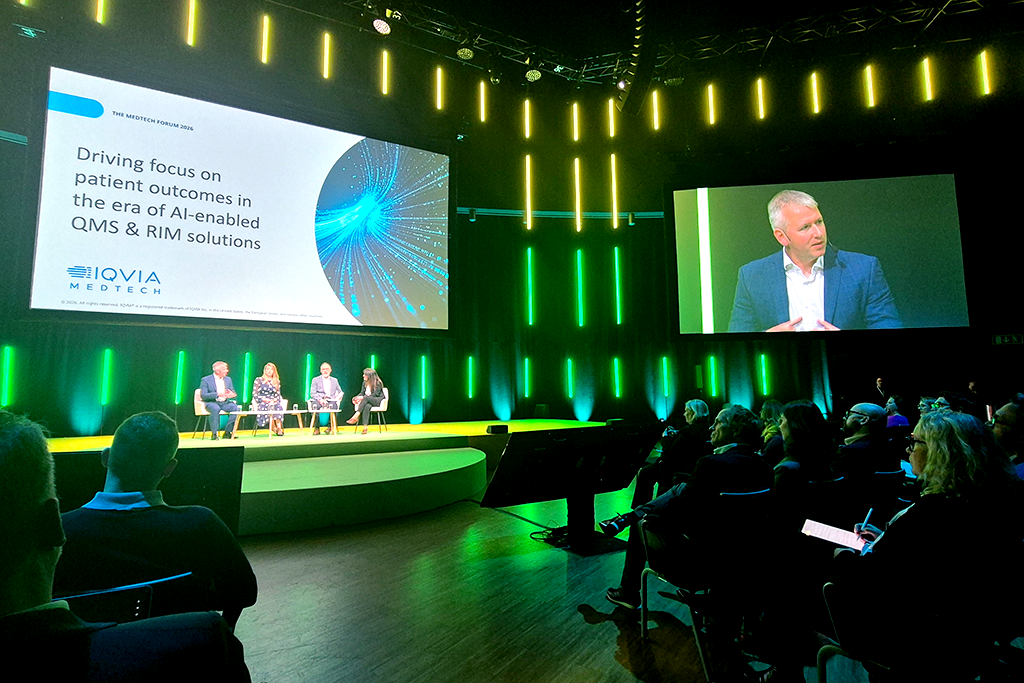
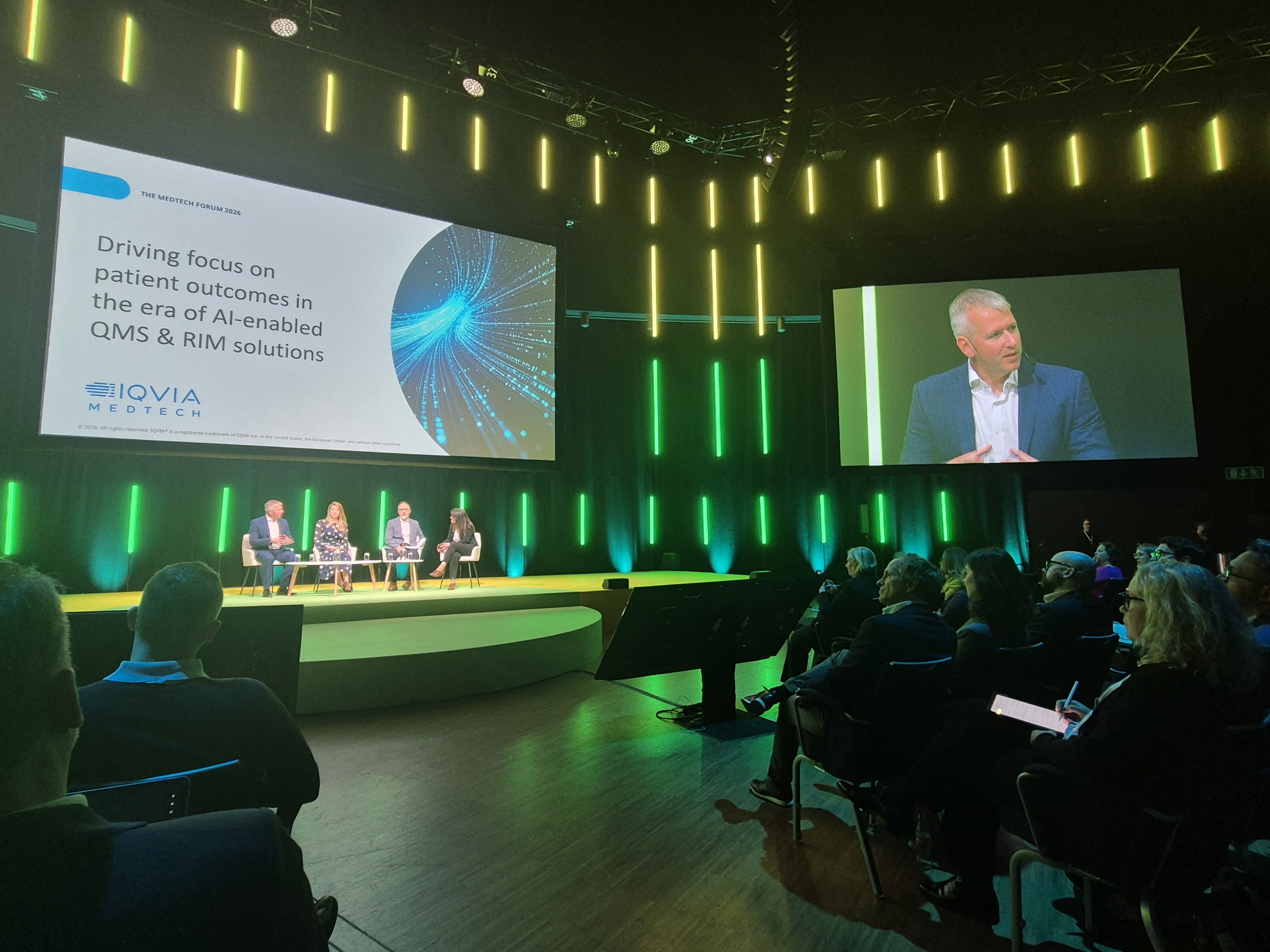
At the MedTech Forum on May 12th, 2026, in Stockholm, Sweden, MedTech industry leaders from quality, regulatory, and healthcare technology came together to discuss how organizations can responsibly adopt AI-enabled Quality Management System (QMS) and Regulatory Information Management (RIM) solutions while keeping patient outcomes at the centre of innovation.

The session was moderated by Olatz Fruniz, Sr. Dir., Quality, Regulatory, Safety Compliance, at IQVIA MedTech, and featured:

  • Natalie Stanyon, Head of Quality Management and Regulatory Systems, Fresenius Medical Care
  • Stephen Lee, Director, Diagnostics and Digital Regulation, ABHI
  • Michael King, Senior Director, Product & Strategy (Quality, Regulatory, Safety & Detect), IQVIA Medtech

The discussion explored how organizations are evolving from fragmented, paper-based systems toward connected digital ecosystems — and ultimately toward AI-enabled operations designed to improve patient safety, accelerate decision-making, and strengthen global regulatory compliance.

Challenges are particularly pronounced in areas such as diagnostics and digital health, where AI models rely on large, diverse datasets and are deployed across multiple healthcare systems. At this scale, global data becomes an enabler of more consistent and internationally applicable approaches to demonstrating safety and performance.
AI adoption starts with digitalization

While AI, especially generative AI, dominates current industry conversations, panellists emphasized that most organizations are still earlier in their digital and AI transformation journey.

“People are mostly starting the conversation not at AI, but at digitalization,” noted Stephen Lee. For many organizations, the immediate challenge is modernizing core Quality Assurance and Regulatory affairs (QARA) functions such as post-market surveillance, adverse event reporting, product registrations, clinical evidence management, and CAPA workflows.

Only after these foundational systems are digitized can organizations effectively layer AI capabilities, fit for purpose in a regulated environment, in a way that benefits operational effectiveness, process repeatability, resource utilisation and compliance.

That reality creates a highly uneven landscape across medtech. Some companies operate advanced enterprise platforms, while others still rely heavily on spreadsheets, shared drives, or paper-based systems. Natalie Stanyon described Fresenius Medical Care’s own transformation journey as moving from “a very heterogeneous world with a lot of sites with home grown and bespoke systems” toward a more harmonized digital environment. The organization is now beginning to evaluate where AI can deliver meaningful value — not because AI is fashionable, but because it can improve decision-making and operational focus. That directly pulls through to improved patient outcomes.

Patient outcomes as the north star

Throughout the session, panellists repeatedly returned to a core principle: AI adoption should begin with a clearly defined patient-centred problem statement.

For Michael King, this means asking fundamental questions:

  • Where are the most significant opportunities for a company?
  • What regulations and standards are around activities related to those opportunities?
  • What potential solutions are available to drive improved activities in an AI enabled solution?
  • Which regulatory or quality decisions could be improved through better insight?

Whether supporting pre-market submissions or post-market surveillance, AI’s role is not simply automation. Its value lies in helping organizations detect product performance trends and signals faster, identify data patterns earlier, and make more informed decisions in quality and regulatory processes that ultimately improve patient outcomes.

For example, this is especially relevant in global complaint handling and adverse event reporting, where organizations can use AI to process vast amounts of structured and unstructured data across a range of data sources such as social media, email inboxes and even audio call centre records.

AI can help identify “the needle in the haystack,” as King described it — surfacing hidden trends, off-label usage patterns, or emerging risks that might otherwise go unnoticed.

Importantly, panellists stressed that AI is not replacing QARA expertise. Instead, it augments human decision-making by allowing professionals to focus on higher-value analysis and critical judgment from QARA professionals.

Governance is the real regulatory issue

One of the most discussed topics during the session was the FDA’s recent warning letter referencing inappropriate AI use in GxP environments.

The panel’s consensus was clear: the issue was not AI itself — it was governance.

The warning letter highlighted failures in process validation, oversight, and accountability within regulated environments. For panellists, this underscored a broader reality for medtech organizations: AI must operate within the same GxP expectations relevant to its industry as any other validated system or process does today.


You can’t delegate decision-making responsibility to AI

Human accountability remains non-negotiable.

The panel also highlighted an important nuance: regulators are not prohibiting AI use. In fact, there is an implicit expectation that organizations will increasingly adopt AI-enabled solutions. However, regulators expect companies to demonstrate:

  • Clear governance structures
  • Defined intended use cases
  • Appropriate validation
  • Human oversight
  • Data integrity controls
  • Ongoing monitoring and review

As Michael King noted, regulators are scrutinizing “the governance of AI,” not endorsing or rejecting any particular tool.

Data quality determines AI quality

Another major theme was the critical role of data quality.

AI systems are only as effective as the data that feeds them. Poorly structured, inconsistent, or incomplete data can create misleading outputs, introduce risk and/or bias, and undermine trust in AI-driven processes.

Natalie Stanyon pointed to free-text fields and inconsistent user behaviour as common challenges within enterprise systems. Once AI is layered on top, organizations may suddenly surface trends or anomalies they have never previously identified — including inaccurate or misleading patterns.

This creates a new operational requirement: organizations must be prepared not only to deploy AI, but also to continuously evaluate, validate, and correct its outputs.

AI implementation is therefore not a one-time software deployment. It is an ongoing operational and governance capability.

The future QARA Professional: patient advocate and technology orchestrator

The discussion also explored how QARA roles are evolving.

Panellists agreed that the core mission of quality and regulatory professionals will not change: protecting patients and ensuring safe, effective products reach the market to drive improved outcomes for global patient populations.

What is changing is the environment in which those responsibilities are executed.

Quality needs to have a mindset in IT and IT needs to have a mindset in quality

Future QARA professionals will increasingly need:

  • Digital literacy
  • Understanding of AI-enabled systems
  • Knowledge of validation and governance expectations
  • Ability to collaborate effectively with IT and data teams
  • Skills to explain AI-driven decisions to regulators and executives

Natalie Stanyon described this evolution as a convergence between quality and IT.

“Quality needs to have a mindset in IT and IT needs to have a mindset in quality,” she said.

At the same time, panellists stressed that human expertise remains irreplaceable. Experienced professionals bring contextual judgment, intuition, and clinical understanding that AI cannot replicate.

Michael King referred to this as “the nose of QARA” — the instinct that something may not be right even when the data appears acceptable.

That human judgment remains essential for patient safety.

AI in medical devices raises the stakes

The panel also examined the distinct challenges of AI embedded directly within medical devices.

Using the example of insulin dosing systems for diabetes management, Michael King highlighted how clinical context fundamentally changes risk.

If an AI-enabled weather application produces an inaccurate prediction, the consequence may simply be getting caught in the rain. But if an AI-enabled insulin algorithm produces an incorrect dosage recommendation, patient harm can occur immediately.

This reinforces the need for:

  • Robust validation
  • Clinical oversight
  • Human review
  • Context-aware risk management

At the same time, panellists acknowledged the enormous potential of AI-enabled devices in areas such as imaging, diagnostics, and early disease detection, where AI can improve both efficiency and clinical outcomes when properly governed.

Regulation is still evolving

Audience discussion extended into emerging global regulatory frameworks, including the EU AI Act and evolving UK approaches to AI governance. A key area of discussion was that, whilst AI specific regulation is evolving globally, the healthcare industry has established regulations in place that are specifically designed to protect patient safety, and which already provide a framework of governance for activities involving QARA professionals.

One recurring challenge that was discussed involved continuously learning AI systems and large language models (LLMs), where traditional software validation models may no longer fully apply.

Panellists acknowledged that industry-wide best practices for validating continuously adaptive AI systems remain immature.

Organizations are still actively learning:

  • How to validate non-deterministic outputs
  • How to manage explainability challenges
  • How to operationalize “human in the loop” or “human in command” oversight
  • How to monitor AI model and output drift over time

As one audience member observed, there is an important distinction between “human in the loop” and “human in command.”

That distinction may become increasingly important as AI capabilities mature.

Key takeaways for MedTech leaders

As medtech organizations evaluate AI-enabled QMS and RIM solutions, the panel offered several consistent recommendations:

  1. Start with patient outcomes
    AI should solve meaningful patient, quality, or regulatory challenges — not simply automate for automation’s sake.
  2. Build strong digital foundations first
    AI effectiveness depends on high-quality, connected, digitized data environments.
  3. Governance matters more than hype
    Organizations must validate, monitor, and govern AI systems within existing GxP expectations.
  4. Human oversight remains essential
    AI can support decision-making, but accountability always remains with the organization and its professionals.
  5. Cross-functional collaboration is critical
    Successful AI adoption requires alignment between QARA, IT, clinical, and executive stakeholders.
  6. Define use cases clearly
    Organizations should approach AI deployments with the same rigor used to define the intended use of a medical device.

Moving forward responsibly

AI-enabled QMS and RIM solutions have the potential to transform medtech operations — accelerating regulatory processes, improving trend analysis and signal detection, enhancing operational consistency, and enabling more proactive quality management.

But the panel’s message was ultimately pragmatic rather than futuristic.

Responsible AI adoption is not about replacing human expertise. It is about empowering experienced professionals with better tools, stronger insights, and faster access to critical information — all while maintaining patient safety as the guiding principle.

As the session concluded, one idea resonated above all others:

If AI deployment does not ultimately improve patient outcomes, then organizations should question why they are implementing it at all.

AI-enabled eQMS and RIM platforms
Contact us to discuss our eQMS and RIM solutions.
IQVIA MedTech Quality Assurance
Transform MedTech quality and compliance into a strategic advantage with IQVIA MedTech.

FAQs

MedTech companies are exploring AI-enabled Quality Management System (QMS) and Regulatory Information Management (RIM) solutions to improve decision-making, strengthen regulatory compliance, enhance operational efficiency, and ultimately support better patient outcomes.
The panel highlighted that most organizations must first digitize core quality and regulatory processes before AI can deliver meaningful value. Connected, digitized systems provide the foundation needed for AI-enabled capabilities to support quality assurance and regulatory activities.
AI can help organizations identify trends faster, detect patterns within large datasets, support complaint handling and adverse event reporting, and provide insights that help quality and regulatory professionals make more informed decisions.
No. The panellists agreed that AI is intended to augment human expertise rather than replace it. Human judgment, experience, and accountability remain essential for quality and regulatory decision-making and patient safety.

Related solutions